



Employee stock options explained – warrants, QESOs, and incentive programs

Updated: 27 August 2025
Options are an effective tool for companies that want to reward key individuals, create incentives, and tie employees to the company's long-term success. But what is an option, how does it work, and what rules apply in Sweden? This guide explains the basics, different types of options, tax rules, and what you should consider as an employee or business owner.
What is an option?
An option is an agreement that gives the holder the right, but not the obligation, to buy or sell an underlying asset (such as shares) at a predetermined price during a specified period. The party selling the option, known as the option issuer, is obliged to fulfill the agreement if the holder chooses to exercise the right.
Options are a type of financial instrument and belong to the derivatives family, meaning their value is based on the value of something else, such as shares, currencies, or commodities.
Example: If you have an option to buy a share for SEK 100 in one year and the share is then worth SEK 150, you can exercise the option and make a profit of SEK 50 per share. If the share price is instead lower than the strike price, you let the option expire. You therefore do not risk money simply by holding the option, which is an important difference compared to buying the share directly.
Call and put options
Options are often divided into call options and put options:
- Call option: Gives you the right to buy a share or another asset at a predetermined price.
- Put option: Gives you the right to sell a share or another asset at a predetermined price.
In Swedish companies, call options are most commonly used in incentive programs. The purpose is to reward key individuals and create a strong link between the employee's contribution and the company's increase in value.
European and American options
Options can also be categorized by how and when they can be exercised:
- European option: Can only be exercised on a specific date.
- American option: Can be exercised at any time up to the maturity date.
Note that these terms have no connection to geographic regions, as both types are traded globally. They refer solely to the contractual format. American options offer greater flexibility, which often makes them more valuable than European options.
Warrants and employee stock options
A warrant is a security that gives the holder the right to purchase newly issued shares in the company at a fixed price during a certain period. Warrants are often used as a reward for key employees and may also be granted to investors as an alternative to convertible debt.
Employee stock options, on the other hand, are not securities but a promise from the employer that the employee may acquire shares at a later date. They are typically subject to a vesting schedule — meaning the right to exercise them is earned over time. Taxation occurs only when the option is exercised, allowing incentives without immediate tax for the employee. To ensure compensation even if the options cannot be exercised, many companies include a clause for alternative compensation, such as cash payment.
Qualified employee stock options
Special Swedish rules for qualified employee stock options provide favorable tax treatment:
- Taxation occurs only when the shares are sold (capital income).
- No employer social security contributions upon acquisition or sale.
- Typically available to small, unlisted companies with a limited number of employees.
Synthetic options
Synthetic options function like regular options but provide cash compensation instead of shares. The compensation is based on the difference between the share's market value and the strike price. These options can be freely transferred and are not affected by continued employment. If the option is not exercised before the end of its term, it expires.
Why do companies use options?
Options are primarily used to:
- Reward key individuals and motivate them to contribute to the company's value.
- Combine fixed salary with the opportunity for future gains.
- Preserve liquidity, as the company does not pay out cash immediately.
- Ensure long-term engagement in the company.
For example, a startup may grant employees options representing a small ownership stake, creating incentives for everyone to work toward the same goal: value growth and success.
Frequently asked questions about options
1. What happens if the share price falls below the strike price?
The options expire, and you do not risk more money than what you paid for the options.
2. Can options be sold to others?
Only certain types, such as warrants and synthetic options, can be freely sold. Employee stock options are usually personal.
3. Are options the same as shares?
No. Options only give the right to purchase shares in the future. They are not shares themselves.
Options directly in your digital share ledger
With NVR, it is easy to bring both ownership structure and incentive programs together in one place. Instead of keeping track of multiple files and manual updates, you can administer warrants, convertibles, qualified employee stock options (QESO), and other conditional instruments.
You can configure programs yourself based on the company's needs: add participants, define terms, pricing, and conditions, and manage changes over time. Participants can also easily access their programs through their ownership account.
Read more about our option service here.
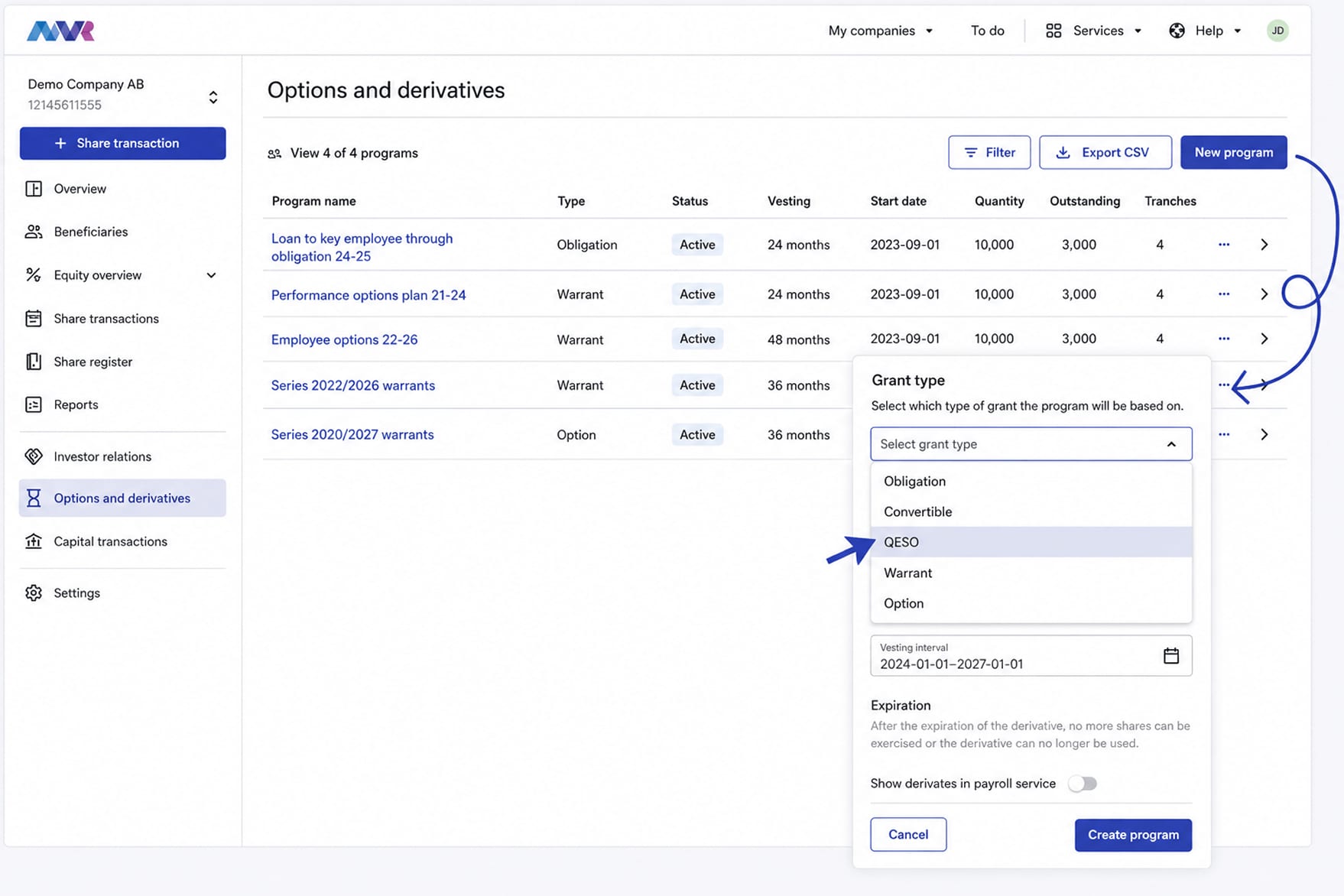
By consolidating all information in NVR, it becomes easier to:
- maintain an up-to-date and accurate share ledger,
- simplify administration,
- communicate clearly with both employees and investors.
The result? Less manual work, more control, and professional management of ownership and options.
Want to see how it works? Book a demo and we'll show you.
Disclaimer: This article is intended for informational purposes only and should not be interpreted as legal advice. It is recommended to consult a qualified professional for specific guidance on legal matters.
NVR: Lena Green appointed CEO

Klarna: How employee equity was seamlessly managed ahead of the IPO
