


Share reclassification – how it works and when to use it

Share reclassification – sometimes called conversion of shares – means changing one class of shares into another within the same company, for example converting an A share into a B share, or vice versa. The new class may be an existing share class or a completely new one. The process is governed by the company's articles of association and the Swedish Companies Act.
What does a share reclassification mean in practice?
When a share is reclassified, its rights change – for example, how many votes it carries (A shares often carry more votes than B shares) or what dividend rights it entails. Different share classes can have different financial and control-related terms.
How the reclassification is recorded depends on the type of company. In private and public coupon companies, the change is registered in the share ledger. For record date companies, the registration instead takes place with Euroclear.
If the reclassification results in a change to the articles of association – for example, if a new share class is introduced – this must also be registered with the Swedish Companies Registration Office.
Why carry out a share reclassification?
There can be several reasons for reclassifying shares, for example:
- Adjust the balance of control – By converting A shares into B shares (or vice versa), a company can change how voting power is distributed among shareholders.
- Prepare for investment or a stock exchange listing – B shares with lower voting rights can be issued to new investors without transferring control of the company.
- Simplify the ownership structure – Having a single share class can reduce administrative complexity and make the company more attractive to investors.
- Succession planning or tax planning – In family-owned companies, different share classes can be used in inheritance or transfers to manage ownership and taxation.
- Comply with agreements or incentive programs – In some cases, a specific share class is required for shares to be included in, for example, an option program.
Read specific examples of share reclassification further down the page.
How do you reclassify shares?
The process typically follows these steps:
- Review the articles of association
- For a reclassification to be permitted, the articles of association must explicitly allow conversion between share classes.
- Decision by the board or shareholders
- The reclassification is decided either by the board of directors or by the shareholders at a general meeting, depending on what is stated in the articles of association. If the reclassification requires an amendment to the articles, a resolution of the general meeting is always required.
- Register the reclassificationOnce the decision has been made, the conversion must be registered:
- If the share ledger is maintained in NVR, the change can be made quickly and smoothly directly in the system.
- If the share ledger is maintained in another way, the company is responsible for updating it manually.
- If the articles of association are amended, this must be registered with the Swedish Companies Registration Office.
- If the company is a record date company, Euroclear must also be notified.
Managing share reclassification in NVR
If you still maintain the share ledger manually or in another system, reclassification often requires updating each individual share holding affected — while at the same time preserving the historical record.
In NVR, the process is significantly simpler. With just a few clicks, you can register the reclassification directly in the share ledger without losing any information. The event is recorded, and the share ledger and all related reports are updated accordingly.
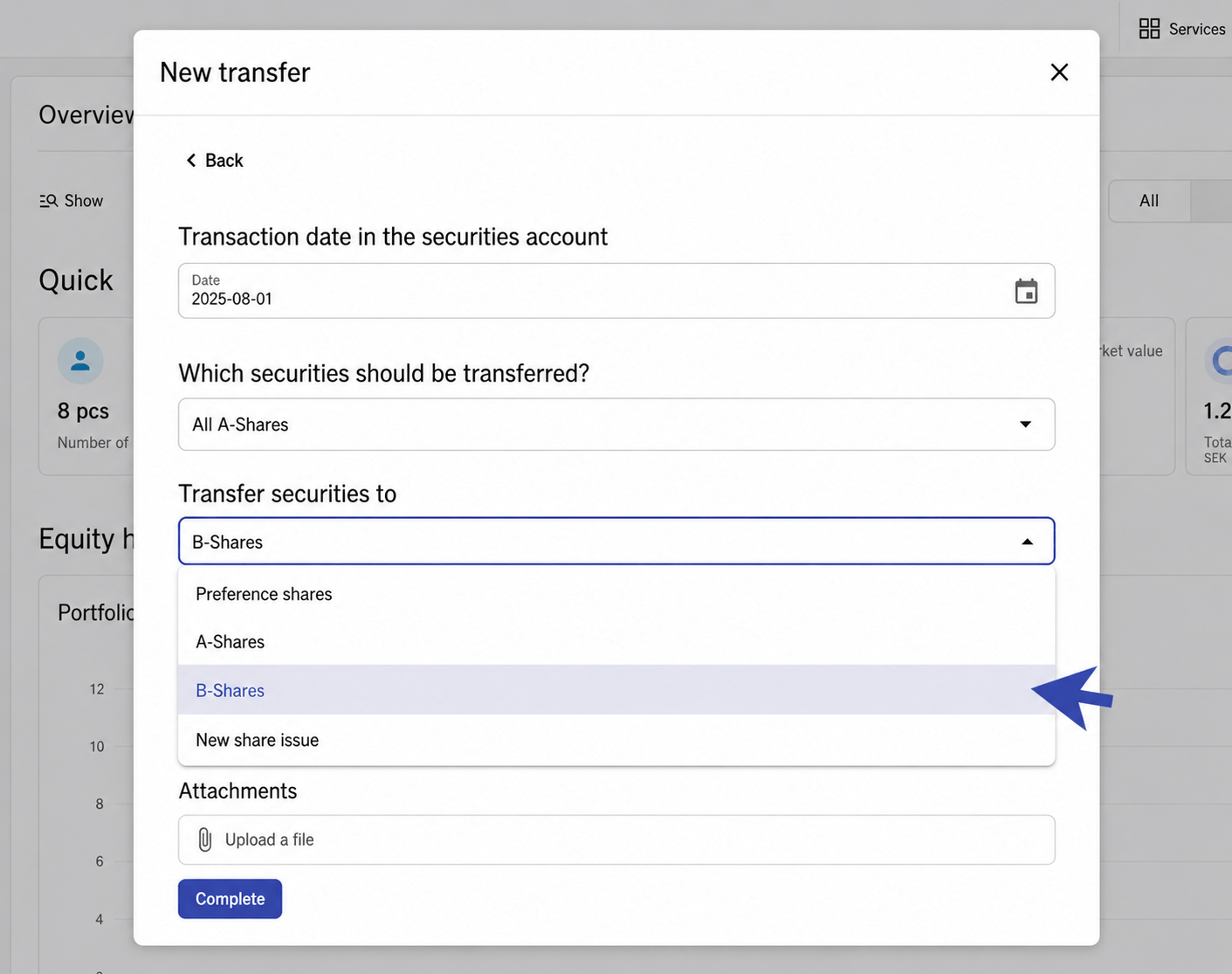
The event is recorded, and the share ledger and all related reports are updated accordingly.
Read our step-by-step guide to learn how it works.
Examples of share reclassification
Below are two examples – a family-owned company and a venture capital–backed growth company – where share reclassification is governed by the articles of association and shareholders' agreements. Both illustrate the use of multiple share classes (A, B, C, Pref) and how these can be reclassified based on specific conditions.
Example 1: Family-owned company with generational succession
Background:
A Swedish family-owned company, “Familjebolaget AB,” is run by the third generation. The company has the following share classes:
- A shares: 10 votes per share – held by the founding family.
- B shares: 1 vote per share – held by younger generations and key individuals.
- C shares: 0.1 votes – issued to grandchildren as future ownership.
- Pref1: Preference shares with priority dividend rights, issued to heirs who are not operationally active.
Regulated in the shareholders' agreement:
- Conversion of C to B
- When a holder of C shares turns 25 and is active in the business, C shares may be reclassified into B shares to provide greater influence.
- Conversion of Pref1 to A
- If a Pref1 holder is elected by the family as chair of the board, their Pref1 shares may be reclassified into A shares.
- Reverse conversion
- If a shareholder leaves the company or becomes passive, A or B shares may be reclassified into C or Pref1 shares to reduce control and dividend rights.
Purpose:
Enable controlled distribution of ownership.
Incentivize active family members.
Protect the company from passive ownership with voting rights.
Example 2: Venture-backed growth company – “GrowthTech AB”
Background:
“GrowthTech AB” has raised multiple funding rounds from venture capital investors. The company has the following share classes:
- A shares: Founders' high-vote shares (10 votes).
- B shares: Ordinary common shares (1 vote).
- C1 shares: Incentive shares for management and employees.
- C2 shares: “Growth shares” for future key individuals.
- Pref1: Series A investors, with dividend preference rights.
- Pref2: Series B investors, with higher dividend preference than Pref1.
Regulated in shareholders' agreements and term sheets:
- C1 & C2 to B shares
- If the company reaches certain milestones (e.g. SEK 100 million in ARR and an IPO), C1 and C2 shares convert to B shares, for example at a 1:1 ratio.
- Pref1 to B shares
- After five years or upon an exit (e.g. IPO or acquisition), Pref1 shares automatically convert to B shares, removing dividend preferences.
- Pref2 to A shares
- Pref2 shares may be converted into A shares in a vote on an exit where Pref2 represents at least 50% of invested capital, providing temporarily increased control.
- Downside protection
- If the valuation falls below a certain level (an anti-dilution trigger), Pref1 and Pref2 may convert into a greater number of B shares under a full ratchet mechanism.
Purpose:
- Protect venture capital investments through preference and conversion rights.
- Incentivize the team to reach defined milestones.
- Enable a controlled balance of power between founders and investors.

KU31: a guide to the statement of earnings for dividends

NVR: Lena Green appointed CEO
