



What is vesting? A guide to vesting schedules, cliffs, and good/bad leavers

Updated: June 4, 2026
Vesting may sound technical, but the idea is actually simple: you earn the right to shares or options over time, or when certain predefined targets are met — this is called a vesting schedule. The purpose is to link ownership to long-term commitment and performance. For the company, this reduces the risk of transferring shares or options to someone who leaves after a short time. For you as an individual, it becomes clearer how and when you actually become an owner.
What is vesting?
When employees receive shares or options through an incentive program, there are almost always clear conditions governing how they can be retained. These are regulated in a vesting clause, which describes how many shares or options can be earned and over what period of time (usually 3–5 years). A vesting clause therefore includes both a general structure (the vesting program) and a time frame (the vesting period). If the conditions are not met, the company or the owners may reclaim what has not yet vested.
Vesting is particularly common in employee option programs. Read more in our introductory guide to options.
Three common vesting structures
There are three common approaches. The first two can also be combined into a third, so-called hybrid structure:
1. Time-based vesting
Here, vesting is determined by how long you remain with the company. This can be structured in different ways:
- Linear: an equal portion vests each month/quarter/year (e.g. 25% per year over four years).
- Back-loaded: a smaller portion vests initially, with a larger portion vesting later. Example: after 1 year, 10% has vested; after 2 years, a total of 35%; after 3 years, a total of 65%; and only after 4 years is everything fully vested.
- Cliff: nothing vests initially. Only after a certain period (e.g. 1 year) does a larger portion vest all at once. After that, vesting typically continues on a linear basis monthly or quarterly.
This is by far the most common model, as it is both simple and clear, without leaving room for subjective interpretation.
2. Milestone-based vesting
In this structure, vesting is linked to specific targets, such as sales figures or the delivery of defined projects.
3. Hybrid
A combination of time and milestones, where you must both remain with the company for a certain period and achieve defined targets.
What happens if someone leaves?
Regardless of the vesting structure, it is important that the terms clearly regulate the pricing and handling of unvested securities (i.e. not yet earned) when someone leaves the company. The reason for departure often matters greatly: retirement, illness, or redundancy are typically handled more favorably than a resignation without valid cause.
In these situations, the concepts of good leaver and bad leaver are often used. These determine not only whether the securities may be retained, but also the price the company pays in a buyback.
Why vesting is used in incentive programs
A well-designed vesting structure serves several important purposes:
- Aligns time horizons. Ownership grows in step with contributions over multiple years, creating a natural long-term focus.
- Creates fairness over time. Early contributions are rewarded, while those who join later can also become owners if they stay and perform.
- Reduces friction. Clear rules reduce conflicts over “who deserves what” in situations such as reorganizations, acquisitions, or IPOs.
The purpose of vesting is not to lock people in, but to clarify the rules of the game: what is required for ownership to become yours, and when.
Key legal building blocks
Agreements such as employment contracts, option terms, shareholders' agreements, or a specific vesting clause form the basis for how vesting works. Formal resolutions at a general meeting are often also required (for example, in connection with the issuance of options or shares), and the terms must always be consistent with the shareholders' agreement.
To avoid ambiguity, it is important to specify:
- vesting period and any cliff
- what qualifies as a good/bad leaver
- buyback rights and pricing
- who determines practical matters (e.g. how milestones are measured and verified)
As an entrepreneur or company executive, it is wise to always seek legal advice tailored to your specific structure.
Taxation — when, what, and how is it determined?
Taxation can occur at different points: when options are granted, when they vest, when they are exercised, or when shares are sold. Vesting is often central, as it is frequently the point at which a security or option is considered available, which determines when the value becomes taxable.
The type of instrument also matters — qualified employee stock options, warrants, or shares — and the applicable terms determine exactly how and when taxation occurs. Details such as deferred payouts or record dates can also affect when something is deemed available and therefore taxable.
Because tax rules are complex, it is always advisable to consult a tax advisor before finalizing the structure and communicating it internally.
Coming soon: Manage option vesting easily in NVR
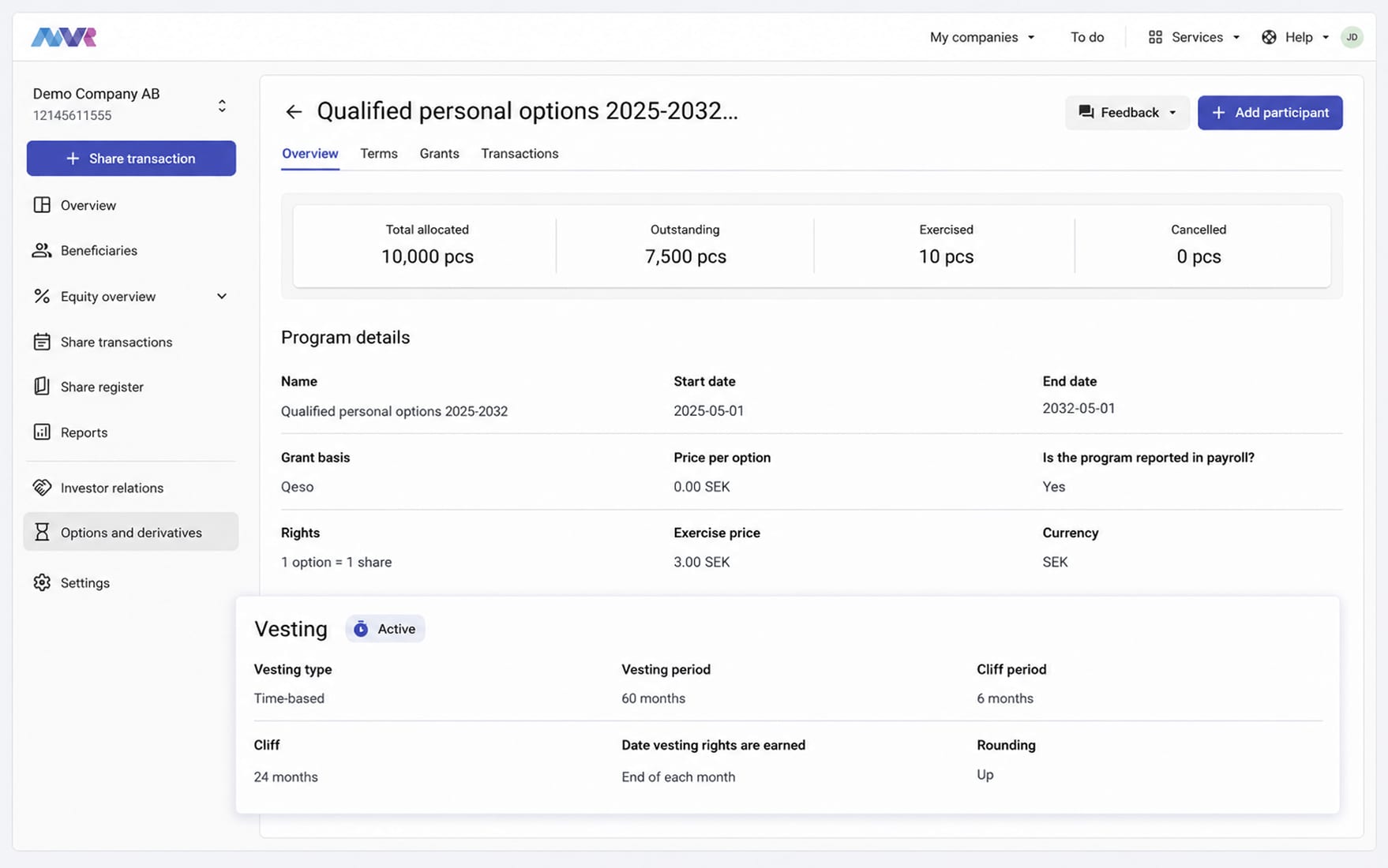
Soon, you will be able to manage time-based vesting for options and derivatives directly in our option service. This gives companies full control over incentive programs and provides participants with clear visibility into how their ownership develops over time.
Vesting will be clearly displayed in the overview for each program, and you can easily link options to a vesting model you define yourself — with total duration, intervals, and any cliff period before vesting begins. Unvested options may, according to the program terms, be repurchased by the company or cancelled. We handle both scenarios automatically and always retain full history, so you can easily track what has vested and what has not.
Support for share vesting will also be added later – Contact us if you would like to learn more.
Looking to evaluate or set up a new incentive program?
With NVR, you can easily get started on your own with the administration of option or incentive programs, ensuring that both the share ledger and the option register always reflect reality. If you need additional support, we are happy to help you set up and follow up on the program, with full traceability and a clear overview of vesting, ownership stakes – and soon, vesting management as well.
NVR: Lena Green appointed CEO

Klarna: How employee equity was seamlessly managed ahead of the IPO
